Commercial Flat Roof Ponding Mitigation & Membrane Repair in Springfield, IL
Specialized Central Illinois damage mitigation, technical diagnostic procedures, and emergency contractor dispatch for residential and commercial properties in Springfield, IL.
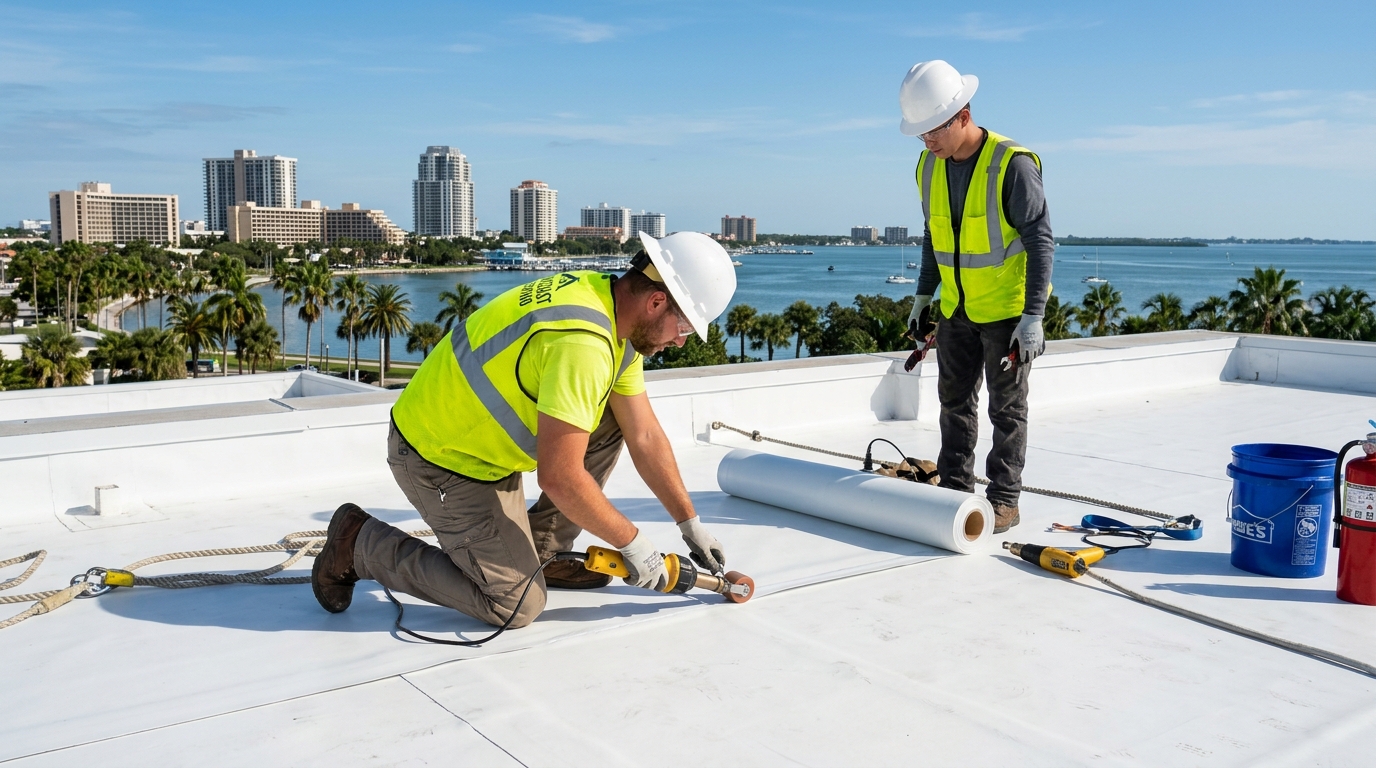
Low-slope and flat roof assemblies on commercial storefronts, downtown historic mixed-use buildings, medical plazas, light industrial warehouses, and modern residential structures across Springfield face severe hydraulic stress. By definition in the National Roofing Contractors Association (NRCA) manual, ponding water is standing water that remains on a roof surface 48 hours or longer following precipitation. In Central Illinois, unmitigated ponding water acts as a magnifying lens for summer solar UV rays and transforms into destructive ice lenses during freezing winter snaps.
Ponding water exerts immense hydrostatic pressure on membrane laps, accelerates the breakdown of bituminous adhesives, and creates localized deck sagging under thousands of pounds of concentrated weight. When water penetrates a low-slope membrane—whether TPO, EPDM, PVC, or dual-ply SBS modified bitumen—it spreads horizontally through underlying polyisocyanurate (polyiso) insulation boards, destroying thermal R-values and rusting steel decking. Dispatched commercial roofing crews execute surgical emergency patches, clear internal drains, and engineer positive drainage crickets.
Commercial Flat Roof Emergency Protocols:
- Emergency Interior Water Diverters: Deploying industrial ceiling containment sumps and catchment bladders to protect business equipment and inventory.
- FLIR Infrared Subsurface Moisture Scans: Mapping the horizontal migration of water through waterlogged polyiso roof insulation boards without exploratory coring.
- Robotic Hot-Air Welded TPO Patches: Executing monolithic thermoplastic welds along punctured single-ply membrane sections for permanent watertight integrity.
- Drain & Scupper Hydraulic Clearance: Clearing mechanical leaf grates, clearing internal drain conductor heads, and restoring unimpeded runoff flow.
1. Regional Microclimate Dynamics & Severe Storm Exposure
Hydraulic Load Physics & Structural Deck Deflection: One inch of standing water over a 100-square-foot roof section weighs approximately 520 pounds. On older commercial buildings in Sangamon County, this concentrated dead load causes structural wood or steel deck joists to bow downward, deepening the ponding depression and accelerating seam delamination.
The open agricultural topography surrounding Sangamon County offers minimal surface friction against fast-moving supercells descending from the Illinois River Basin. Prairie winds generate dynamic uplift pressures that expose subtle installation flaws in edge metal flashings and steep-pitch valleys. When sudden downpours coincide with 60+ MPH wind shear, standard gravitational water shedding fails, necessitating immediate on-call physical mitigation.
2. Non-Destructive Moisture Diagnostics & FLIR Thermal Tracing
Infrared Thermography & Capacitance Diagnostics: Dispatched commercial specialists deploy FLIR thermal imaging cameras immediately following sunset. Because saturated polyisocyanurate insulation has higher thermal mass than dry insulation, it retains daytime solar heat longer, glowing brightly on infrared sensors to reveal the exact moisture boundary.
Water entering through an exterior shingle breach rarely drops directly down. In older Springfield homes with tongue-and-groove decking or dimensional lumber joists, moisture follows gravitational slope lines for thirty to fifty feet before penetrating ceiling drywall. Dispatched specialists trace these concealed paths accurately with calibrated radio-frequency impedance meters and infrared thermography, saving homeowners thousands of dollars in unnecessary drywall exploratory destruction.
3. Step-by-Step Substrate Restoration Methodology
Surgical Membrane Patching Methodology: Technicians power-wash the damaged membrane zone with specialized solvents, abrade the surface, and mechanically weld a color-matched TPO/PVC patch using a 1,000°F robotic hot-air welder, achieving seam tensile strength exceeding 120 lbs/in.
Contractors utilize standardized manufacturer procedures endorsed by the Asphalt Roofing Manufacturers Association (ARMA) and NRCA. Fasteners are extracted with flat precision tools to prevent tearing the underlying water-shedding underlayment. The substrate deck is thoroughly inspected for rot or soft spots, reinforced where required, and capped with high-grade architectural assemblies designed to endure future Central Illinois weather cycles.
4. State Energy Efficiency Codes & Contractor Licensing Compliance
Illinois Energy Code & Commercial Compliance: Low-slope restorations satisfy Illinois Energy Conservation Code mandates requiring minimum continuous R-30 insulation performance, ensuring commercial properties maintain energy efficiency and municipal compliance.
Illinois law strictly regulates roofing contractors to protect consumers from fraudulent storm chasers following major weather events. Dispatched contractors in our referral network hold verified licenses in good standing with the Illinois Department of Financial and Professional Regulation (IDFPR), carry comprehensive insurance, and comply with all City of Springfield Office of Building and Zoning permitting requirements.
5. Preventative Property Maintenance & Storm Preparedness
Preventative Drainage Maintenance: Property managers receive actionable guidance on installing tapered polyiso saddles, inspecting perimeter coping stone mortar joints, and implementing bi-annual drain clearance schedules to prevent structural ponding.
Routine proactive inspection of roof penetrations, chimney mortar joints, and valley troughs prevents minor weathering from becoming a middle-of-the-night ceiling disaster. Springfield property owners are encouraged to schedule professional post-storm evaluations whenever hailstones exceed one inch or local prairie wind gusts reach 50 MPH.
Active Storm Emergency in Springfield or Sangamon County?
Do not allow active roof leaks or wind-damaged shingles to destroy interior ceiling plaster and structural framing. Immediate telephone crew dispatch routing right now.
DISPATCH ON-CALL CREW: (888) 208-4155