Emergency Prairie Wind Roof Tarping & Tree Impact Defense in Springfield, IL
Specialized Central Illinois damage mitigation, technical diagnostic procedures, and emergency contractor dispatch for residential and commercial properties in Springfield, IL.
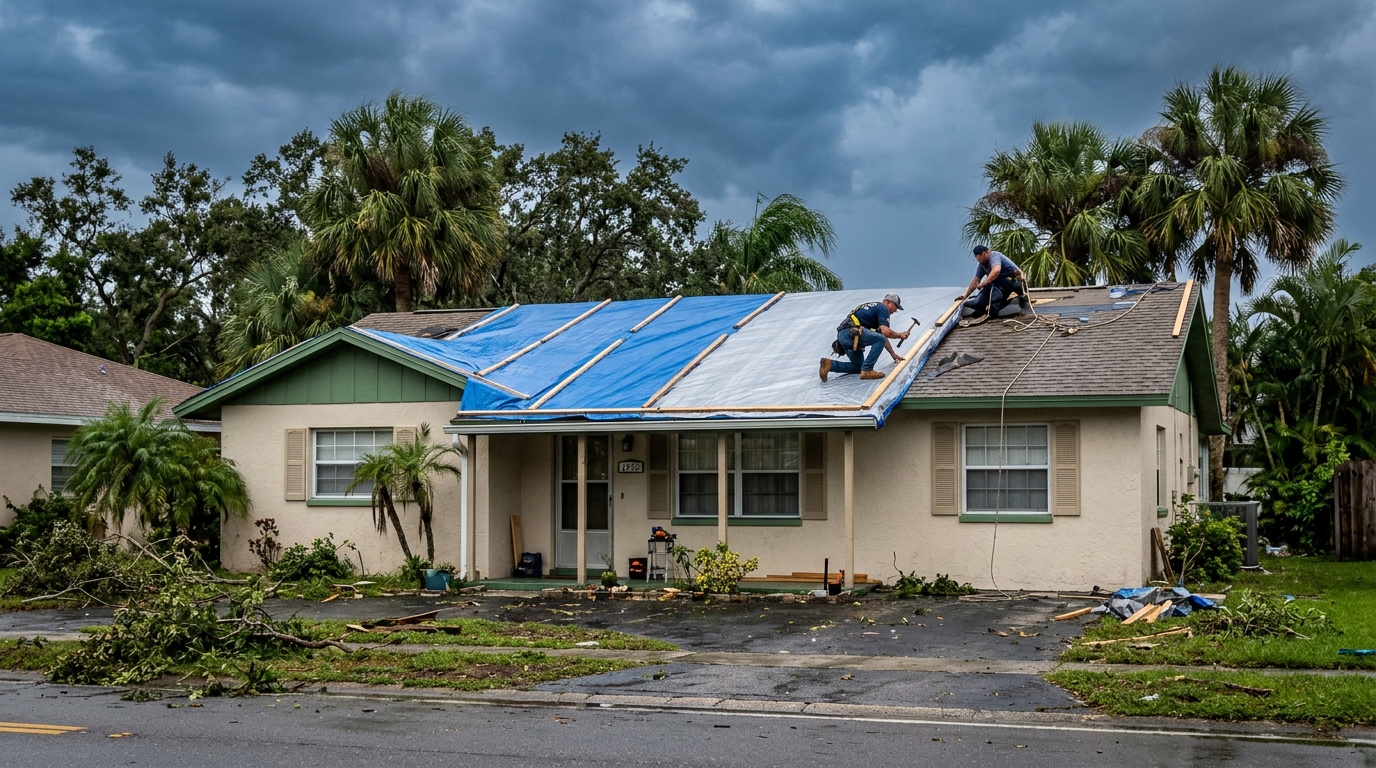
Severe straight-line prairie winds, convective downbursts, and fallen hardwood branches routinely strip shingle courses and puncture plywood roof sheathing across Springfield and Sangamon County. When bare roof decking is exposed to the elements, standard shingle repairs cannot be executed in the middle of an active torrential storm. Emergency roof tarping serves as the primary tactical barrier required to protect your home's structural framing and interior living spaces from catastrophic inundation.
Amateur tarping utilizing lightweight blue utility sheets secured with staplers, bricks, or sandbags inevitably fails during Midwest prairie gusts. Dispatched emergency crews deploy commercial-grade 10-mil woven polyethylene tarps engineered with UV inhibitors and high tear resistance. Tarps are wrapped securely over the roof ridge to ensure continuous gravitational water shedding, and mechanically fastened using 2x4 spruce timber battens screwed directly into structural roof rafters.
Tactical Roof Tarping Standards:
- Ridge-Over Encapsulation: Wrapping the upper edge of the tarp over the roof peak to prevent high winds from catching the top seam and funneling water underneath.
- Kiln-Dried Timber Battens: Continuous 2x4 spruce battens anchored with 3-inch exterior screws into rafters, eliminating flapping and eyelet tear-out.
- Puncture & Impact Stabilization: Plywood sheathing reinforcement over tree limb impact punctures prior to weather membrane encapsulation.
- Insurance-Compliant Documentation: Detailed pre-tarping and post-tarping photographic records satisfying your homeowner policy's mitigation requirements.
1. Regional Microclimate Dynamics & Severe Storm Exposure
Prairie Wind Shear & Tarp Aerodynamics: Central Illinois prairie winds create localized negative pressure vortices along roof rakes and eaves. Non-structural tarps quickly balloon and detach under 40 MPH gusts. Mechanically fastened timber battens distribute wind loads evenly across roof rafters, resisting sustained gale forces up to 75 MPH.
The open agricultural topography surrounding Sangamon County offers minimal surface friction against fast-moving supercells descending from the Illinois River Basin. Prairie winds generate dynamic uplift pressures that expose subtle installation flaws in edge metal flashings and steep-pitch valleys. When sudden downpours coincide with 60+ MPH wind shear, standard gravitational water shedding fails, necessitating immediate on-call physical mitigation.
2. Non-Destructive Moisture Diagnostics & FLIR Thermal Tracing
Substrate Moisture Protection: Prior to tarp deployment, dispatched technicians inspect the surrounding shingle matrix using FLIR thermal imaging to verify that trapped water is not trapped beneath the tarp envelope. Adequate ventilation gaps prevent attic condensation while locking out exterior precipitation.
Water entering through an exterior shingle breach rarely drops directly down. In older Springfield homes with tongue-and-groove decking or dimensional lumber joists, moisture follows gravitational slope lines for thirty to fifty feet before penetrating ceiling drywall. Dispatched specialists trace these concealed paths accurately with calibrated radio-frequency impedance meters and infrared thermography, saving homeowners thousands of dollars in unnecessary drywall exploratory destruction.
3. Step-by-Step Substrate Restoration Methodology
Engineered Mechanical Fastening Methodology: Technicians measure the breach zone with a minimum 4-foot perimeter overlap. Battens are rolled into the poly tarp edges to form a watertight hem, then fastened into rafters with ceramic-coated exterior screws fitted with rubber neoprene sealing washers.
Contractors utilize standardized manufacturer procedures endorsed by the Asphalt Roofing Manufacturers Association (ARMA) and NRCA. Fasteners are extracted with flat precision tools to prevent tearing the underlying water-shedding underlayment. The substrate deck is thoroughly inspected for rot or soft spots, reinforced where required, and capped with high-grade architectural assemblies designed to endure future Central Illinois weather cycles.
4. State Energy Efficiency Codes & Contractor Licensing Compliance
Sangamon County Building Code & Safety Compliance: Emergency tarp installations comply with OSHA 1926 subpart M fall protection mandates and local building codes. Dispatched contractors utilize full-body harnesses, rope grabs, and temporary roof anchors to ensure zero workplace accidents on steep pitches.
Illinois law strictly regulates roofing contractors to protect consumers from fraudulent storm chasers following major weather events. Dispatched contractors in our referral network hold verified licenses in good standing with the Illinois Department of Financial and Professional Regulation (IDFPR), carry comprehensive insurance, and comply with all City of Springfield Office of Building and Zoning permitting requirements.
5. Preventative Property Maintenance & Storm Preparedness
Subsequent Permanent Restoration Path: While an engineered timber-batten tarp provides 60 to 90 days of weather-tight protection, our referral desk coordinates next steps for permanent shingle tear-off, decking re-sheathing, and full storm restoration by licensed local craftsmen.
Routine proactive inspection of roof penetrations, chimney mortar joints, and valley troughs prevents minor weathering from becoming a middle-of-the-night ceiling disaster. Springfield property owners are encouraged to schedule professional post-storm evaluations whenever hailstones exceed one inch or local prairie wind gusts reach 50 MPH.
Active Storm Emergency in Springfield or Sangamon County?
Do not allow active roof leaks or wind-damaged shingles to destroy interior ceiling plaster and structural framing. Immediate telephone crew dispatch routing right now.
DISPATCH ON-CALL CREW: (888) 208-4155